HiddenLogicHQ Publications
Stop Explaining Yourself
How to Hold Your Ground With People Who Twist Your Words
The moment you begin explaining, you have accepted that a charge was made.
Instant digital download • Written by Charles E. Adikwu
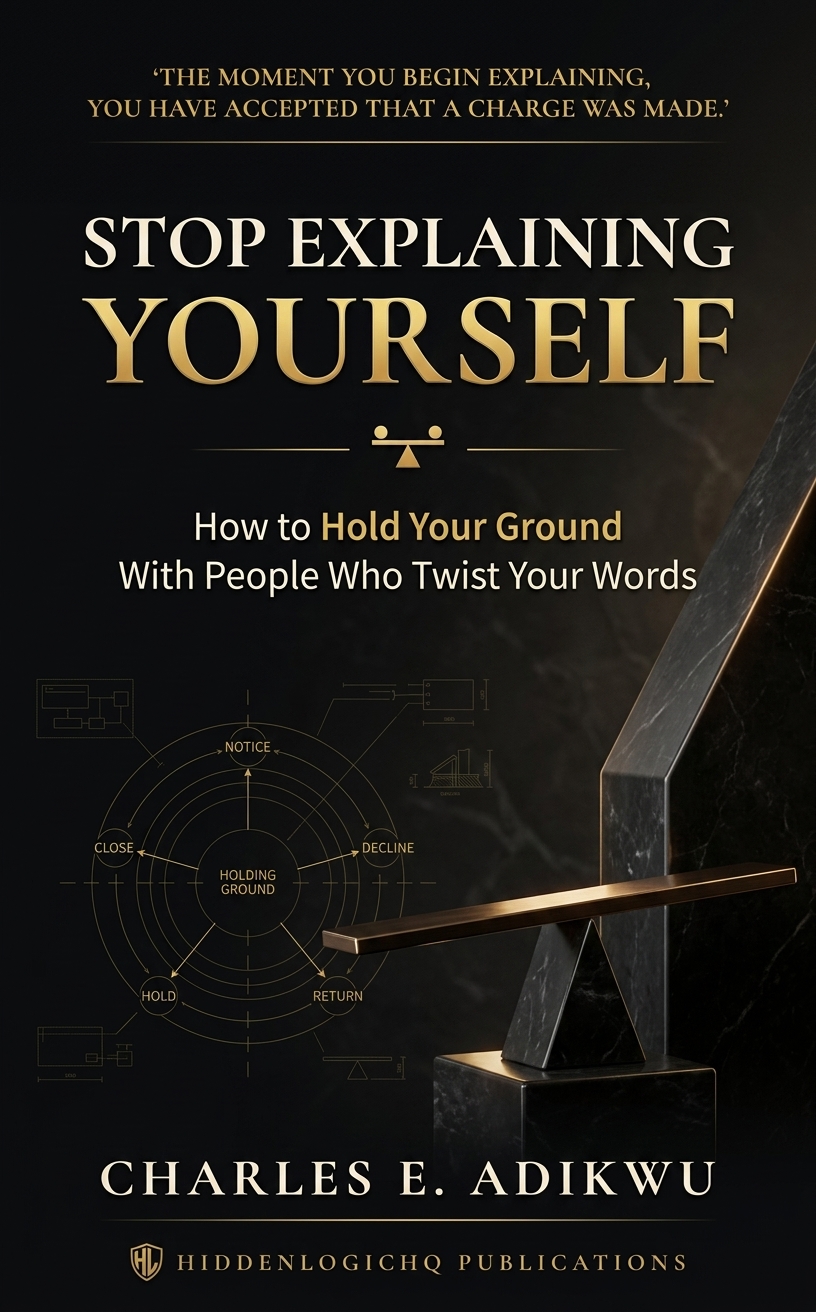
The moment you begin explaining, you have accepted that a charge was made.
You walk into a conversation with a legitimate concern. Forty minutes later you walk out having apologised. Somewhere in the middle your words came back different, small concessions accumulated into a position you never agreed to, and the burden of proof landed on you without anyone naming it.
That is not a communication failure. It is a structural one. The conversation was decided before you started explaining.
Stop Explaining Yourself shows you how the allocation of burden happens in the first ninety seconds, why more explanation is not a stronger defence but a larger payment, and how small, reasonable concessions quietly assemble into a conclusion you would have rejected outright.
Explaining Is the Currency
It then gives you the practical methods for holding ground: correcting once and recording always, returning the burden by asking the claim to become specific, saying less than feels adequate, and conceding only deliberately — with a stated boundary.
This book is about conversations, not relationships. It concerns the review, the negotiation, the argument that circles for an hour. If the difficulty is a sustained pattern with one person over months, that is a different problem.
What You Will Learn
- How the conversation is decided before you start explaining
- Why explaining is the currency and more of it is a larger payment
- How death by small concessions works and how to stop it
- What to do when your words come back wrong
- How to return the burden of proof
- Why saying it once, the same way, and stopping is stronger than elaborating
- How to concede deliberately or not at all
- Why the same-day record is the only version that survives six weeks later
- How to end the exchange yourself instead of letting attrition decide
- How to still be standing where you started
What’s Inside
10 practical chapters organized into three clear parts. Diagnostic tools for spotting the allocation in the first minutes. Specific methods for holding a position without escalating. Clear guidance on when to concede and when not to. A complete system for long-game conversations. Plus Tactical Glossary and Research Notes.
What Changes When You Apply This
Stop walking out of conversations having apologised for a legitimate concern
Spot the moment the burden of proof is allocated against you
Prevent small concessions from assembling into a position you never agreed to
Correct distortions once and let the record do the rest
End exchanges on your terms instead of by exhaustion
Hold ground without becoming the person who explains endlessly
This Book Is For
- Anyone who has entered a meeting, review, or difficult conversation with a clear point and left having apologised.
- Professionals, managers, and anyone who keeps finding their words twisted and their position eroded by the end of the exchange.
You are not trying to win. You are trying to still be standing where you started. Still being where you started is the only form of winning these conversations offer.
The Central Idea
You do not owe them an explanation.
The moment you begin explaining, you have accepted that a charge was made. The methods in this book exist so that the conversation ends with you still standing where you started.
About the Author
Charles E. Adikwu writes about human behavior, decision-making, and the psychology beneath ordinary social life. His work takes research that usually stays inside academic journals and turns it into things people can actually do in meetings, negotiations, and difficult conversations. Stop Explaining Yourself is the seventh in a connected set. He publishes under the HiddenLogicHQ imprint.
You walked in with a legitimate concern. You do not have to walk out having apologised.
Instant access • Digital download • HiddenLogicHQ Publications